
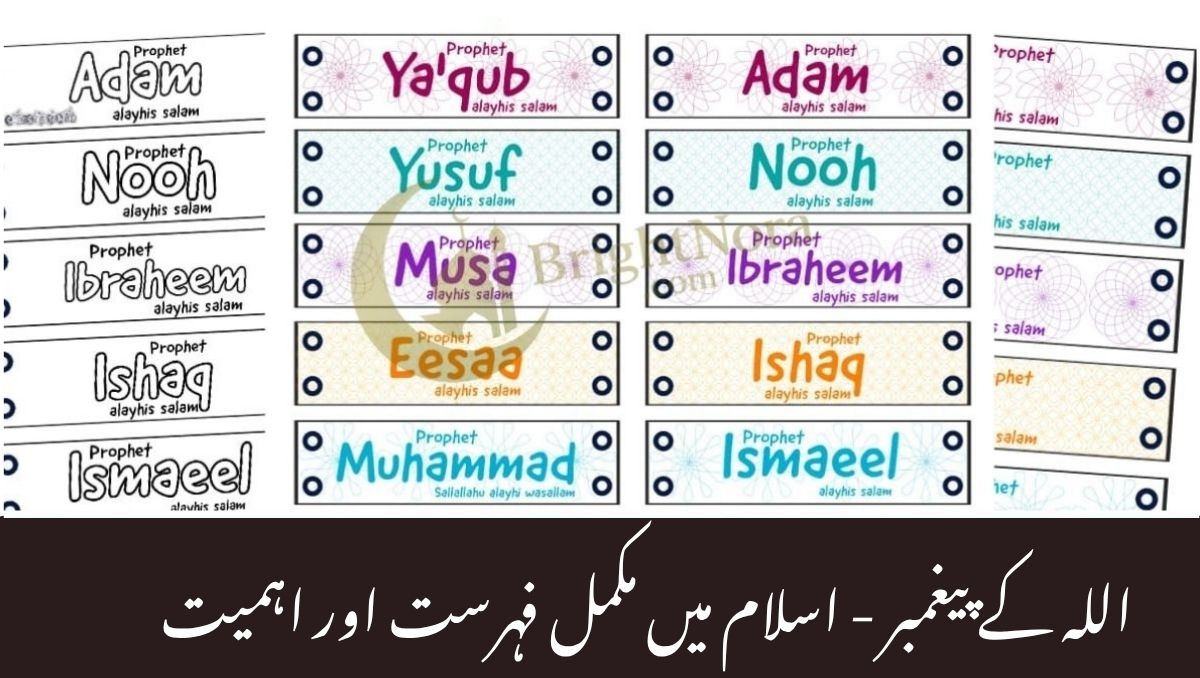
It is believed that Allah (SWT) selected several Prophets of Allah to recite His teachings, a fact widely acknowledged. However, two main questions surrounding them are: how many Prophets of Allah were there, and who are they? If you have any questions surrounding the Prophets of Allah, read on as we explain everything you need to know about them.
Visit Now: https://brightnora.com/
What is a Prophet in Islam?
Islamic prophets are messengers sent by Allah (SWT) to demonstrate ideal behaviour and spread the word and teachings of Allah (SWT) to people on Earth.
How many Islamic Prophets are there?
Allah (SWT) selected 25 prophets to spread His messages.
Read More: Islamic Dua in Urdu – 10 Powerful Duas for Success
Who is the Prophets of Allah?
Adam is the first among the Prophets of Allah. He and Hawwa (Eve) were the first humans on Earth, and Adam is considered the father of the human race. It is said that Allah (SWT) created Adam and Eve from clay and gave them free rein in Paradise. He told them that they might have anything they wanted, but He forbade them from eating the fruit of one tree in Paradise. But they disobeyed Him and sinned. As a punishment, Allah (SWT) sent them to Earth, where Adam had to learn how to grow crops, bake, and survive – skills which he passed down to his descendants as one of the Prophets of Allah.
Adam and Eve had many children, including Abel, Cain, and Seth. Abel and Cain were both asked by Allah (SWT) to present a suitable sacrifice. Allah (SWT) accepted Abel’s effort but rejected Cain’s. In a fit of rage and jealousy, Cain threw a rock at Abel and killed him, resulting in the first murder on Earth. Following this, when the time came for Adam to choose a successor, he decided on Seth, who became the second prophet.
Idris
Idris was born in Babylon and followed the rules and teachings of Prophet Sheeth. So, when he came of age, he received the Revelation, and Allah (SWT) bestowed prophethood upon him. During his time in Babylon, he warned others not to commit sins; however, they didn’t listen, and this caused him to leave. Some people followed him to Egypt, where he invested a great deal of time in preaching, worshiping, and researching his ancestors, Adam and Eve. It’s thought that he possessed great wisdom during his time in Egypt and became the first man to use a pen to write, earning him a respected place among the Prophets of Allah.
Nuh
Nuh received the message from Allah (SWT) that unless people started to recognise Him as the one true God, a great disaster would happen. Nuh tried his best to warn people that if they continued to worship multiple gods, then Allah (SWT) would punish them. Despite this, the people didn’t listen, and in an attempt to preserve life, including those who eventually listened to him, Nuh built an ark. On the ark, he admitted a pair of each type of animal and awaited the arrival of the Great Flood – Allah (SWT) warned this would happen, and it did.
Hud
Hud lived in ʿād, and at the time, he was the only one devoted to Allah (SWT) as the sole god. He was desperate for people to listen to him when he said there was only one god, but they refused and mocked him. This mocking led Allah (SWT) to create a thunderous storm and destroy ʿĀd.
Saleh
Allah (SWT) sent Saleh to spread His teachings and preach against the wealth and selfishness in Thamud. The people of Thamud refused to believe Saleh until Allah (SWT) performed a miracle. So, Allah (SWT) gifted the people of Thamud a she-camel, but they hamstrung the camel. Saleh warned them that there would be consequences to their actions and disbelief, and Allah (SWT) punished them in the form of an earthquake.
Ibrahim
Because of the actions of the Prophets of Allah, especially Prophet Ibrahim, to this day, Muslims carry out Qurbani sacrifices during Eid al-Adha. Allah (SWT) commanded Ibrahim to sacrifice his son, Ismail. Both Ibrahim and Ismail agreed that they must obey Allah (SWT); however, at the last minute, Allah (SWT) swapped Ismail for a ram and spared his life, revealing that the command had been a test.
Lut
Allah (SWT) sent Lut to the cities of Sodom and Gomorrah to promote monotheism and teach people about sins. When he said that the people of the cities were sinning, they didn’t listen, and this led to the cities being destroyed.
Ismail
Ismail was the son of Ibrahim and promoted Allah’s (SWT) teachings just like his father.
Ishaq
Ishaq was Ismail’s brother and Ibrahim’s son, meaning he continued to spread the word of Allah (SWT) as those before him had done.
Yaqub
Yaqub is mentioned 16 times in the Quran – he was the father of 12 tribes and was described as a man of might.
Yusuf
Yusuf was the son of Yaqub, and his father loved him dearly, which led to jealousy among his brothers, causing them to throw him into a well. Some people who were travelling discovered him and enslaved him before imprisoning him for a crime he didn’t commit. Even in such hardship, his faith in Allah (SWT) didn’t waver.
Ayyub
Allah (SWT) harshly tested Ayyub for years, but he remained strong in his faith, and Allah (SWT) rewarded him for this.
Shu-ayyb
Allah (SWT) sent Shu-ayyb to the Midlanite community as a prophet to spread His teachings and warn people that they’d be punished if they didn’t change their fraudulent ways. They didn’t listen, and their community was destroyed. Shu-ayyb is known as the most eloquent of the prophets.
Musa
Musa is mentioned more than any other person in the Quran. It’s said that he and Prophet Muhammad (PBUH) shared multiple parallels.
Harun
Harun was the brother of Musa and the first high priest of the Israelites.
Dhu’l-Kifl
Dhu’l-Kifl was mentioned twice in the Quran and preached the word of Allah (SWT) throughout Iraq.
Dawud
Dawud was a soldier for King Talut and defeated the giant, Jalut. He also received the Zabur (biblical psalms) and was one of the very few prophets to have achieved this.
Read More: Names of All Prophets: 25 Prophets Mentioned in the Quran
Sulaiman
Sulaiman was the son of Dawud and took over his prophecy when he died. Sulaiman was the king of Israel, and it was believed that he could communicate with animals and Jinn. He’s hailed as one of the greatest rulers of all time, and it’s said that no king before or after him could reach his level.
Ilyas
Ilyas lived in the northern kingdom of Israel. At the time, people who worshipped the ancient god Baal also lived here. Ilyas told them about Allah (SWT), defending Him and remaining loyal to Him.
Al-Yasa
Al-Yasa is briefly mentioned in the Quran as having miracle powers, being able to walk on water, revive the deceased, and cure the diseased. It’s believed that Ilyas raised him.
Yunus
Allah (SWT) sent Prophet Yunus to the city of Nineveh in northern Iraq, as the city was full of idol worshippers. Yunus attempted to inform the people of Nineveh that Allah (SWT) is the only god and guide them on the right path. Despite this, they rejected him, and Yunus left Nineveh against Allah’s (SWT) will. So, Allah (SWT) turned the sky red above Nineveh and brewed an awful storm.
The people of the city dropped to their knees and begged for mercy, which Allah (SWT) granted. At this time, Yunus was travelling by boat; he knew that this was his punishment for leaving and sacrificed himself for the sake of others. He dived into the sea and was swallowed by a whale; upon repenting to Allah (SWT), he was allowed to return to Nineveh.
Zakariyya
Zakariyya was the father of Yahya, who became the guardian of Mary, the mother of Isa.
Yahya
Yahya was the son of Zakariyya, and Allah (SWT) informed him of Isa’s arrival. Yahya was known as a merciful and gentle man who was committed to Allah (SWT) – in his whole life, he didn’t do one thing against the will of Allah (SWT).
Isa
Allah (SWT) sent Isa to guide the people of Israel on a straight path. He’s mentioned 93 times in the Quran, and it’s said that Allah (SWT) revealed the gospel to him.
Muhammad (PBUH)
Muhammad (PBUH) is the last of the Prophets of Allah in Islam, and he was sent by Allah (SWT) to confirm the teachings of the prophets before him. He’s widely considered the father of Islam, as Allah (SWT) had the Angel Jibril reveal the Quran to him. Muhammad (PBUH) then recited the teachings of the Quran for over 23 years.
Originally, he lived in Mecca, where he spread the word of Allah (SWT) to people who believed in multiple gods. This led to him and his followers being persecuted, so they left for Medina. Years later, Muhammad (PBUH) and his followers returned to Mecca, where they were shown respect by those who had previously persecuted them.
A Timeline of Prophets in Islam
The chronology of prophets in Islam is as follows:
- Adam – Being the first human being, Adam’s exact time period isn’t defined.
- Idris – Pre-flood era.
- Nuh – Approximately 950 years before the flood (the Pre-Abrahamic period).
- Hud – Post-flood era.
- Saleh – Post-flood era.
- Ibrahim – Approximately 2000 BCE.
- Lut – Contemporary with Ibrahim.
- Ismail – Approximately 1900 BCE.
- Ishaq – Approximately 1900 BCE.
- Yaqub – Approximately 1800 BCE.
- Yusuf – Approximately 1700 BCE.
- Ayyub – Post-Ibrahimic period.
- Shu-ayyb – Post-Ibrahimic period.
- Musa – Approximately 1300 BCE.
- Harun – Contemporary with Musa.
- Dhu’l–Kifl – Likely post-Musa era.
- Dawud – Approximately 1000 BCE.
- Sulaiman – Approximately 970–931 BCE.
- Ilyas – Post-Sulaiman era.
- Al-Yasa – Post-Ilyas era.
- Yunus – Approximately 8th century BCE.
- Zakariyya – Approximately 1st century BCE.
- Yahya – 1st century CE.
- Isa – 1st century CE.
- Muhammad (PBUH) – 570-632 CE.
Conclusion
In Islam, Allah Almighty chose the Prophets of Allah to guide humanity to the straight path. From Adam to Muhammad, the basic message of worshipping one God and living a good life was in all of their lives. The stories of the Prophets of Allah are filled with powerful lessons that remind Muslims to be steadfast and patient and to remain devoted to Allah Almighty.
FAQ’S
How many Prophets of Allah are mentioned in the Quran?
There are 25 Prophets of Allah mentioned by name in the Holy Quran, each sent to guide humanity toward faith and righteousness.
Who was the first Prophet of Allah?
The first of the Prophets of Allah was Adam (AS), who was also the first human created by Allah Almighty.
Who is the last Prophet of Allah in Islam?
The last and final of the Prophets of Allah is Prophet Muhammad (PBUH), who brought the message of the Holy Quran to all mankind.
Why did Allah send the Prophets of Allah to people?
Allah sent the Prophets of Allah to teach people about worshiping one God, living with justice, and following the straight path of truth.
What can Muslims learn from the Prophets of Allah?
Muslims can learn patience, obedience, faith, and compassion from the lives and teachings of the Prophets of Allah.



Pingback: Importance of Dua in Islam – 5 Powerful Reasons
Pingback: Modern Islamic Baby Girl Names 2025 – Beautiful & Unique
Pingback: 100+ Unique Islamic Muslim Baby Name | Best 2025 List
Pingback: 64 Sahaba Names – Powerful & Inspiring Companions
Pingback: Prophets Stories in Quran – 10 Powerful Lessons