

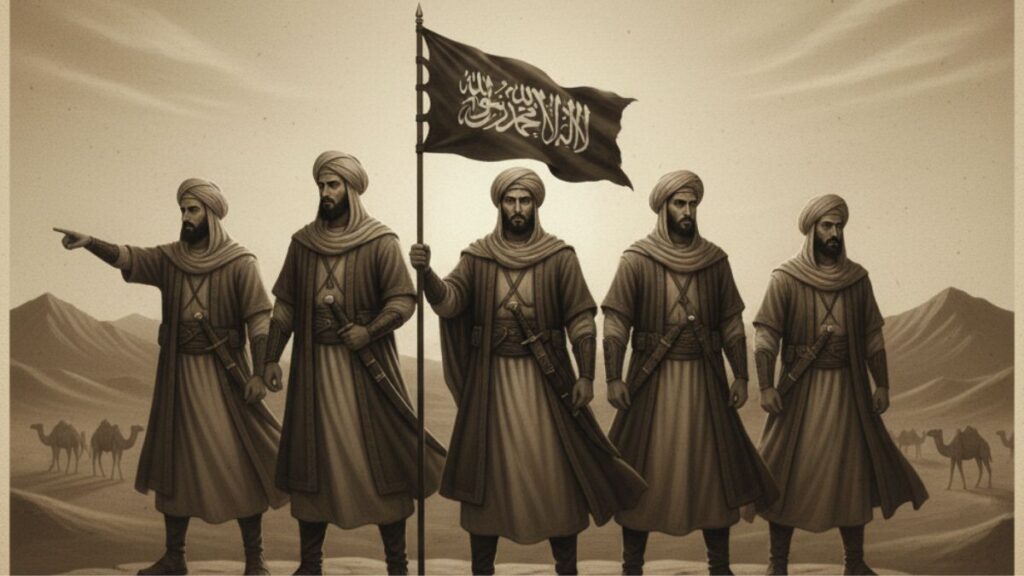
(Arabic: اَلصَّحَابَةُ, “The Companions”) were the Muslim followers of the Islamic prophet Muhammad who saw or met him during his lifetime, believed in his message, and died as Muslims. The exact number of Muhammad’s companions is unknown due to their wide geographical dispersal and the absence of a comprehensive record during his lifetime. However, Sahaba Karam Names suggest there were over 100,000 companions, with some sources, such as Abu Zur’ah al-Razi and Al-Suyut, reporting approximately 124,000.
Visit Now: https://brightnora.com/
Sahaba Karam Names
- Abbad bin Bishr (رضي الله عنه)
- Abdullah bin Amr (رضي الله عنه)
- Abu Dahdaa (رضي الله عنه)
- Julaybib (رضي الله عنه)
- Abu Aqil Ansari (رضي الله عنه)
1) Abbad bin Bishr ( رضي الله عنه )
Abbad bin Bishr (رضي الله عنه – may Allah be pleased with him) was a companion who was known for his worship and knowledge. One day, he stood up for prayer. While absorbed in recitation, a stranger stalked the outskirts of the valley in search of Muhammad ﷺ and his followers. From a distance, the man saw the figure of Abba, so he silently drew his bow and fired an arrow that embedded itself in Abba’s flesh. Calmly, Abbad removed the arrow and went on with his recitation, still absorbed in his salah (prayer).
The attacker shot two more arrows, which also found their mark. Abbad pulled them out and finished his recitation. Abbad continued the prayer to its end and then said to Ammar (another famous companion of Muhammad ﷺ – may Allah be pleased with him): “Get up and stand guard in my place. I have been wounded.” Ammar stood up, and seeing them both, the attacker fled into the darkness. Ammar turned to Abbad, saying, “Why didn’t you wake me when the first arrow hit you?” Abbad replied: “I was reciting verses of the Qur’an, which filled my soul with awe, and I did not want to cut short the recitation.”
Read More: 64 Sahaba Names – Companions of Prophet ﷺ
Lessons learned from his story:
He later recovered from his wounds, but the story of having that deep connection with the salah and the will to complete his salah no matter what made me wonder how my excuses are nothing in comparison. In special cases, we can shorten or join the prayers and even pray while lying down, but we can’t miss the prayer. War, babies, illness, kids – whatever hardship we’re faced with – we can’t leave the prayer behind because it’s the basic pillar of Islam and our moment of peace amidst the chaos! May Allah help us guard our prayers till the last breath leaves our lips. What did you learn from this short story and Sahaba Karam Names?
2) Abdullah bin Amr ( رضي الله عنه )
Abdullah Bin Amr ( رضي الله عنه – may Allah be pleased with him) was the son of the famous companion Amr bin ‘Aas (RA). He was committed earnestly to serving the deen of Allah. So much so that he had to be forced by his father to get married. On his wedding night, Abdullah bin Amr asked his new bride the permission to offer 2 rak’aat of salah. She permitted him, so he went off to pray. In his khushoo of conversing with Allah, he forgot all about his bride and continued praying until the Adhaan of Fajr was heard.
The next day, he promised himself to tend to his bride. The 2nd night, he requested his wife once more to allow him to offer 2 rak’aat of prayer. Again, he forgot all about his marriage and prayed until Fajr. This happened thrice in a row. Until Amr bin Aas came on the 3rd day to check up on his daughter-in-law and asked her about his son Abdullah, so she told him the whole story. Amr bin Aas grabbed his son by the neck and took him to the Prophet Muhammad ﷺ to remind him about the rights of others and of our body on us.
Abdullah bin Amr hence reported that the Prophet ﷺ asked:…”Have I not been informed that you offer prayer all night and fast the whole day?” I said, “Yes.” He said, “Do not do so; Offer prayer at night and also sleep; Fast for a few days and give up fasting for a few days because your body has a right on you, and your eye has a right on you, and your guest has a right on you, and your wife has a right on you.
I hope that you will have a long life, and it is sufficient for you to fast for 3 days a month, as the reward of a good deed is multiplied 10 times, that means, as if you fasted the whole year.” I insisted (on fasting more), so I was given a hard instruction. I said, “I can do more than that (fasting).” The Prophet said, “Fast 3 days every week.”…I said, “I can fast more than that.” The Prophet (ﷺ) said, “Fast as Allah’s prophet David…1/2 of a year (i.e., he used to fast on alternate days)”. He wasn’t given further permission!
Read More:100+ Unique Islamic Muslim Baby Name Ideas with Meanings for Boys, Girls & Twins
Lessons learned from his story:
I learned that each one of us has a different capacity and passion for doing things. Sometimes we’re so engrossed in dunya that we forget the aakhirah, while sometimes we’re so engrossed in the ibaadah that we forget the rights of people Allah has blessed us in this dunya.
Neither extreme is good. We can’t say that we are only going to give the rights of human beings and that’s enough because Allah will forgive us. And we can’t dedicate worship to old age and keep dunya for our youth either. And we can’t say that we’ve given our all to Allah; hence, we won’t be questioned about our responsibilities in terms of our relationships with the people around us. Balance, though hard to find, is something that our religion teaches. And if you see the life of Muhammad ﷺ, you’ll see that this balance is achievable!
This hadith is a clear indication that you CAN achieve balance if you know where your focus should be! May Allah help us all achieve such a balance. What did you learn from this short story and Sahaba Karam Names?
3) Abu Dahdaa ( رضي الله عنه )
Abu Dahdaa ( رضي الله عنه – may Allah be pleased with him) was sitting in the company of Rasoolullah ﷺ, and an orphan came complaining about his neighbour, Abu Lubabah, who wouldn’t give or sell a palm tree that was a cause of problem for him in building a wall around his garden. The Messenger of Allah ﷺ called the man and asked him to give or sell that one single palm tree to this boy, and he refused and got upset.
Later, Prophet Muhammad ﷺ offered him a tree in Jannah in return for that tree, and as he was so upset, he refused and left. Abu Dahdah asked the messenger of Allah ﷺ if that bargain is still valid if he buys that tree?
And the Prophet ﷺ said yes! Hearing that, Abu Dahdah got up and rushed after Abu Lubabah. He offered his meadow to him in return for that tree. The man asked, Are you kidding? It was an offer no one could refuse because who in Madinah didn’t know of that heavenly garden with approximately. 500 palm trees and a well surrounding a house. Hence, Abu Lubabah gave that one palm tree to him, which Abu Dahdah gifted the boy, and he went towards his house in those meadows.
He called his wife Umm Dahdah from the outside, asking her to come out of the house as he had sold it to Allah and His messenger ﷺ – upon which she replied, without any question or resistance: “Allahu Akbar, what a successful bargain!” She then gathered her kids, checked their pockets for any dates from the garden, took them out, and threw them in that garden, stating that they are for Allah now. They are not their property anymore. And hence the whole family left a house with a well amidst a garden of 500 palm trees behind so they could own a tree in Jannah.
Lessons learned from his story:
Whenever I try to de-clutter my life, burdens and belongings, this is the story that I love to read over and over again. This story of a palm tree makes me wonder – When we clutter our homes with so much that we don’t need – the things we can easily live without, why do we keep holding onto them even though they’re not serving us, but can benefit others in many ways? What are the things I can trade for Jannah? What did you learn from this short story and Sahaba Karam Names?
Read More: Morning Duas – Daily Protection
4) Julaybib ( رضي الله عنه )
Julaybib ( رضي الله عنه – may Allah be pleased with him), a companion of the Prophet (ﷺ) who was a man of no societal value. In the Arabic language, “Julaybib” means “small grown,” indicating that Julaybib was perhaps a dwarf. He was also described as being “damim”, meaning “deformed or repulsive”. Nobody knew his parents or his trib, and he was very poor financially – hence no value came in the form of lineage or wealth either. One day, he asked the Prophet ﷺ: “ya Rasool Allah! Do you think the only woman I will get is the hoor-ul-ayn (a woman in Jannah), in sha Allah?” Muhammad ﷺ replied – “No! From this dunya and also from the akhirah.”
So with Julaybeeb in mind, Muhammad ﷺ went to an Ansari and said: “I want to have your daughter married.” Who replied in joy: “How wonderful and blessed…what a delight to the eye (this would be)”. Muhammad ﷺ explained that he’s asking for Julaybib and not himself. The Ansari, who had rejected far better proposals for his daughter before, went to consult with his wife.
His wife protested: “To Julaybib! No, never to Julaybib! No, by God, we shall not marry (her) to him.” (It is said that the daughter was so beautiful that there was none among the women of that clan who could compete with her looks). Her mother told her about Julaybib while crying. The daughter said, “O Mother, how blessed is the status of Julaybib, that God and his Messenger are asking for your daughter’s hand on his behalf.” She agreed and was hence married to Julaybib.
Soon after his marriage, he went on an expedition and was martyred. Companions found his diminutive body lying next to seven men that he had slain…Prophet ﷺ held his body and said. “O Allah, he is from me and I am from Him” (repeating this thrice).
Lessons learned from his story:
You may have heard the stories of a princess and a frog, or Beauty and the Beast, or the hunchback of Notre Dame. This is a beautiful, real story of a halal happily-ever-after that can replace those stories. You will see companions constantly weighing their relationships on the scale of the Quran and Sunnah.
This is the story of a woman marrying a man that no one agreed to marry and in shaa Allah when we discuss the stories of female companions, we will highlight the story of Umm Ayman – an old abyssinian slave who was married to a young man and the adopted son of Muhammad ﷺ because Zaid (رضي الله عنه) wanted to marry a woman of Jannah when Muhammad ﷺ asked who will marry her?! May we always set our relationship goals for the sake of Allah, too. What did you learn from this short story and Sahaba Karam Names?
5) Abu Aqil Ansari ( رضي الله عنه )
Abu Aqil Ansari (رضي الله عنه – may Allah be pleased with him) was one of those companions of the Prophet ﷺ who had the smallest of pockets but the biggest of hearts. When Muhammad ﷺ asked Muslims to bring forth their sadaqah (charity) for the expedition of Tabuk, he had nothing to give. So he went looking for work and found a job with a Jew who needed some water hauling. Abu Aqil was hence among the last to come forth with charity, a Sa` of dates (a few dates).
He said: `O Allah’s Messenger! This is a Sa` of dates. I spent the night bringing water and earned two Sa` of dates for my work. I kept one Sa` (for my family) and brought you the other Sa`. The Messenger of Allah ﷺ ordered him to spread it over all the charity (that others brought). His sadaqah was little but carried the weight of Uhud mountain. Some men mocked Abu Aqil, saying, `Allah and His Messenger do not need this charity. What benefit would this Sa` of yours bring’. They laughed at him, saying,` Allah does not need the Sa` of Abu `Aqil.” – Upon which Allah revealed the verses of the Quran [9:79]
Lessons learned from his story:
I learned that a growth mindset is a gift. He didn’t limit himself to what he didn’t have. He didn’t let a fixed mindset take hold of him. He went out looking for work so he could contribute something, even if it’s a little. I also learned that nothing is too small in front of Allah as long as our hearts are big and our intentions are pure. May Allah accept our sadaqah – little and big – and turn them into valuable treasures with Him too. What did you learn from this short story and Sahaba Karam Names?
Conclusion
The Sahaba Karam Names remind us of authentic faith, fortitude, and loyalty. Each name in Sahaba Karam Names is a lesson of love and sacrifice for Allah. In the study of Sahaba Karam Names, we are inspired to embody the virtues of sincerity and moderation. Let us walk the road of Sahaba Karam Names and gain Allah’s delight both in this life and the afterlife.
FAQ’s
What can we learn from the sacrifices of Sahaba Karam Names?
From Sahaba Karam Names, we learn the true meaning of sacrifice, faith, and love for Allah. Reflecting on Sahaba Karam Names encourages us to stay steadfast and thankful in every situation.
Where can I read authentic Sahaba Karam Names stories?
Authentic stories of Sahaba Karam Names are found in Hadith books and Islamic history sources. Reading Sahaba Karam Names stories connects us deeply with the values of early Islam and strengthens our spiritual growth.
Are Sahaba Karam Names mentioned in the Quran and Hadith?
Yes, Sahaba Karam Names are honored in several Quranic verses and Hadiths. Allah praises Sahaba Karam Names for their loyalty, sacrifice, and unwavering support for Prophet Muhammad ﷺ.
Why should we learn about Sahaba Karam Names?
Learning about Sahaba Karam Names helps us understand the purest form of faith and dedication shown by the companions of the Prophet ﷺ. Through Sahaba Karam Names, we discover real-life examples of patience, courage, and love for Allah.
What makes Sahaba Karam Names special in Islamic history?
Sahaba Karam Names are special because they represent the closest companions of Prophet Muhammad ﷺ who lived with him, learned from him, and spread Islam across nations. Learning about Sahaba Karam Names strengthens our connection to the roots of faith and reminds us how true believers lived with devotion and sacrifice.